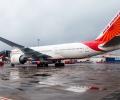
Indian carriers have cancelled over 10,000 flights since the onset of the West Asia conflict, as escalating tensions and airspace restrictions disrupted international operations, a senior government official said.

One Indian oil tanker successfully crossed the Strait of Hormuz, while others turned back after Iran signalled the waterway's closure, amidst rising tensions and disruptions to global energy flows.

Despite Iran allowing 'non-hostile vessels' through the Strait of Hormuz, marine insurance premiums are expected to remain elevated due to persistent high-risk classifications and ongoing geopolitical tensions, with experts cautioning that the threat of attacks and collateral damage still exists.

In April alone, they snapped up shares worth Rs 19,664 crore, recording their biggest buy since October 2024.
India is sending a shipment of diesel and petrol to Sri Lanka to help alleviate the country's energy crisis amidst regional instability.

Congress leader Shashi Tharoor is urging the Indian government to take a more proactive role in mediating the escalating conflict between the US-Israel alliance and Iran, emphasising the impact on India's energy security and regional stability.

Karex, the Malaysian company that makes roughly one in five of the world's condoms -- about five billion a year, supplying Durex and Trojan among others -- announced this week that it is raising prices by up to 30 percent. The reason is the Strait of Hormuz.

Aviation Turbine Fuel (ATF) prices have more than doubled to a record high, impacting airlines and consumers, while commercial LPG rates also see a significant increase.

Nepal is actively involved in rescuing its citizens from Gulf countries due to escalating tensions in West Asia, with thousands registering to return home. The government is committed to ensuring the safety of Nepalese citizens in the region and has formed an Emergency Response Team to manage the crisis.
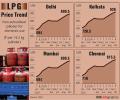
The canteen at the Sports Authority of India's headquarters in Delhi has suspended operations due to a vendor complaint about LPG supply shortages, though sources suggest pricing disputes are also a factor. This closure primarily affects staff, as athletes' meals are provided separately.

Indian equity benchmarks, Sensex and Nifty, ended lower after a spectacular rally, with the Sensex tumbling 931 points, as renewed tensions in West Asia, particularly the risk to the ceasefire deal after Iran closed the Strait of Hormuz, dampened investor optimism.

'In such a scenario, Iran could proclaim itself victor, rebuild, re-enforce its diminished regional proxies to further destabilise neighbouring nations and take control of the Persian Gulf and Strait of Hormuz.'

India's economy registered a robust 7.7 per cent growth in the fiscal year 2025-26, an increase from 7.1 per cent in the previous year, with the January-March quarter alone seeing a 7.8 per cent expansion.

The government has assured citizens that there is no need to panic book LPG cylinders, as uninterrupted supply to households is being ensured despite the ongoing conflict in West Asia.

Kerala Chief Minister Pinarayi Vijayan held an online meeting with Loka Kerala Sabha members in the Gulf region to discuss support for the expatriate community amidst the escalating conflict in West Asia.

As the negotiations continued, the Iranian government said on social media that "talks between Iran and the US in Islamabad entered the expert-level stage as economic, military, legal, and nuclear committees joined in".

'The next two to three weeks will not be decided in Washington.' 'They will be decided in Tehran, in whatever calculation Iran makes about the costs of continued resistance against the costs of appearing to have yielded.'

India's merchandise exports experienced a slight decrease in February, while imports surged due to increased gold and silver purchases, leading to a widened trade deficit. The West Asia crisis is expected to further impact trade in the coming months.

Amid rising tensions, Iran reportedly launched ballistic missiles toward a US-UK military base, prompting concerns about regional stability and the potential for escalating conflict in the Middle East.

The Indian rupee depreciated by 34 paise to close at 93.78 against the US dollar, marking its third consecutive session of decline. This fall is attributed to escalating crude oil prices driven by uncertainty surrounding US-Iran peace talks and fresh attacks in the Strait of Hormuz, alongside significant foreign institutional investor outflows from domestic equity markets.

Gold prices experienced a significant drop in futures trading due to global selloff, inflation concerns, and a strong US dollar. Analysts predict a continued downward trend amid geopolitical tensions and potential rate hikes.
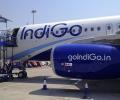
InterGlobe Aviation (IndiGo) is experiencing significant financial pressure, with its stock falling 18 per cent since the start of the Iran war, due to rising Brent crude prices, a weakening rupee, and disruptions to its West Asia and European flight networks caused by geopolitical tensions.

Former Maldives President Mohamed Nasheed advocates for building democratic institutions over military intervention in resolving international conflicts, particularly in the context of the escalating West Asia crisis. He also discusses the impact of the conflict on the Maldives' tourism-dependent economy and calls for a stronger, more understanding India in the Indian Ocean Region.

A new study by AI firm Anthropic reveals that while AI hasn't caused widespread unemployment, it has slowed hiring for younger workers in AI-exposed roles. The study also highlights the gap between AI's theoretical capabilities and actual deployment, and the ongoing conflict between Anthropic and the US government over AI weaponisation.

Indian equities are experiencing their sharpest rebound in years, with the BSE 500 index rallying 12.1 per cent so far this month, echoing Covid-era recoveries despite ongoing geopolitical uncertainty and earnings risks.

Alliances fight wars effectively only when they share an endgame. If Israel acted without US knowledge, then the military alliance is operating without real coordination at the level of strategic targeting. Neither picture is reassuring in a war that is no longer regional in its consequences. Prem Panicker continues his must read daily blog on the Gulf War.
The Indian rupee weakened against the US dollar due to a strengthening dollar, high crude oil prices, and foreign fund outflows amid geopolitical uncertainties.
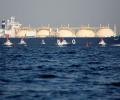
Analysts predict India will face oil price volatility and macroeconomic effects due to the escalating Iran crisis, though the country's oil supply chain is not yet structurally insecure.

The Congress party has criticised the Indian government's diplomatic efforts, questioning how Pakistan was able to secure a role as a mediator between the US and Iran despite India's attempts to isolate it after the Pahalgam attack. The party also raised concerns about India's standing on the global stage and its relationship with the US and China.

For weeks, the war skirted the edge of catastrophe without tipping over. Missiles flew, there was much destruction, commanders were assassinated, cities across the Gulf and even in Israel struggled to absorb the shock. But one line held: Energy infrastructure, the arteries of the global economy, remained largely untouched. That is no longer true. Prem Panicker continues his must read daily blog on the Gulf War.

Maruti Suzuki India reported a significant 147 per cent year-on-year increase in mini-car sales (Alto and S-Presso) during April-May 2026, reaching 32,341 units, driven by eased production constraints and a surge in demand for CNG vehicles amidst rising fuel prices.

Israel wishes to continue its bombing campaign until Iran's military and industrial infrastructure are degraded to a point where it ceases to pose a threat to Israel. Iran, for its part, has learnt from its experience in the 12-day war of last June. Any ceasefire, it believes, will only be a prelude to another attack on itself. It is determined to convey that any attack on Iran will impose heavy costs on Israel, the US, America's allies in the Gulf -- and on the world at large, points out T T Ram Mohan.

India's net oil import bill could rise by $56 billion to $64 billion annually assuming global crude averages $110 to $115 per barrel in FY27.
Infosys Q4 results beat estimates, but weak FY27 guidance triggers cautious brokerage outlook and target price cuts. Should investors worry?

US Secretary of State Marco Rubio will visit India for four days to strengthen bilateral relations, holding talks with Indian leaders and attending the Quad foreign ministers' meeting.

Oil-marketing companies (OMCs) are set to significantly expand the sale of flex fuel (E85) across India, with plans to reach 5,000 outlets in major cities by the end of next year, according to Petroleum Minister Hardeep Singh Puri. This move aims to boost ethanol demand, reduce crude oil imports, and cut carbon emissions, coinciding with the launch of India's first flex-fuel vehicles by Maruti Suzuki and Hero MotoCorp.

The Central government has assured the Bombay High Court that it is taking steps to address the LPG shortage caused by the conflict in West Asia. The court accepted the submission and disposed of a petition filed by LPG distributors.

Foreign brokerages have started to cut their year-end targets for the Nifty 50 index amid the ongoing West Asia conflict.

The Federation of Indian Pilots, said the union has written to the DGCA raising concerns over the extension.

India has denied making any payments to Iran to secure safe passage for its vessels through the Strait of Hormuz, following reports that Indian vessels were fired upon in the region.
